34.2 billion euros in financing for renewable energies
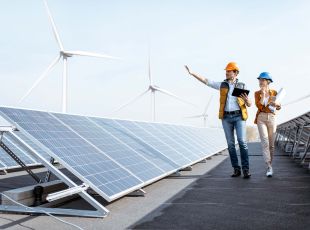
Solar, wind, geothermal, bioenergy... In ten years, BNP Paribas has increased its financing dedicated to renewable energies by five-fold, from 6.9 billion euros at the end of 2014 to 34.2 billion euros at the end of September 2024. The Group has become a major player in the financing of renewable energies, which have seen a strong increase in demand driven by the rapid development and use of Artificial Intelligence (AI). BNP Paribas aims to have 90% of its energy production financing dedicated to low-carbon energies by 2030, with this ratio already at 76% by the end of 2024. To achieve this, BNP Paribas launched the Low-Carbon Transition Group in 2021 to support large corporate and institutional clients in their low-carbon transition.
179 billion euros to support the low-carbon transition since 2022
Between the beginning of 2022 and the end of 2024, BNP Paribas provided 179 billion euros to support its clients in their transition to a low-carbon economy, with a target of 200 billion euros by the end of 2025.
While this indicator is more recent – it dates from the Group's strategic plan, GTS, launched in February 2022 – it demonstrates BNP Paribas' concrete approach to supporting the transition.
The Group is committed to supporting the transition of all its clients, from helping individuals renovate their homes to be more energy-efficient or finance the purchase of an electric vehicle to supporting companies in the transformation of their production methods and financing their transition.
No.1 in Green Bonds between 2015 and 2025
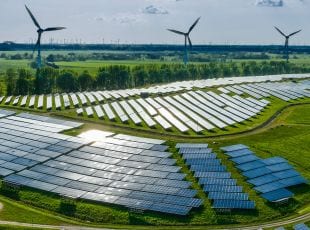
Green bonds are among the products that support large institutional investors in their transition. In 2016, BNP Paribas published its "Green Bond Framework" followed by the issuance of its first green bond. In addition to its own financing, BNP Paribas has supported many sovereign clients, corporates and financial institutions by arranging the bonds they have issued for their environmental projects. According to Dealogic, green bond issuance increased by an average of 37% per year for BNP Paribas between 2015 and 2025, compared to 30% for the market. Furthermore, the Group is ranked number one in green bonds over this period, with around 5% of the global market share.
250 million euros for innovative start-ups committed to the transition
In 2015, BNP Paribas opened an investment envelope of 100 million euros for its own account to support the scaling up of start-ups committed to the energy transition. In the five years that followed, 12 start-ups benefited from direct investments by the Group. One example is CarbonWorks, which captures and recovers CO2 via microalgae. In 2020, this investment envelope was increased to 250 million euros. This additional funding made it possible for the Group to broaden its support, including 86 million euros for the BNP Paribas Solar Impulse Venture Fund managed by BNP Paribas Asset Management*. Open to institutional investors, large companies and clients of the Group's private bank, this fund finances start-ups committed to the ecological transition, including the French start-up Hello Watt, which helps individuals manage the energy consumption and renovation of their homes. In January 2025, the BNP Paribas Solar Impulse Venture Fund reached its final closing of 172 million euros.
133,000 employees trained in sustainable finance challenges
In 2013, two years before the Paris Agreement, the Group set itself a training target related to sustainable finance for the first time ever.
BNP Paribas has continued its efforts to raise awareness on sustainable finance and train all its employees on climate issues. For example, in 2020 the "We Engage" initiative was designed to introduce all teams to environmental and social issues.
In addition, the Group’s “Sustainability Academy” launched in 2022 has led to an increase in trainings for all teams: between 2022 and the end of 2024, nearly 133,000 employees worldwide have been trained thanks to this programme, with nearly 39,000 employees taking part in a Climate Fresk.

-50% of greenhouse gas emissions on the operational perimeter
Between 2015 and 2025, BNP Paribas halved its greenhouse gas emissions per employee, from 2.89 to 1.48 tCO₂eq/FTE (full-time equivalent). This decrease can be explained by the improved energy efficiency of the Group’s buildings, the reduction of business travel, and the increase in initiatives to raise awareness among teams so that every employee is empowered to act responsibly when it comes to their own energy use. These efforts reflect a profound and lasting transformation in the Group's practices.
Lastly, 2.4 million tonnes of the residual emissions from BNP Paribas' operational scope have been offset through the purchase of voluntary carbon credits since 2017.
Ten years after the Paris Agreement, a profound transformation of the economy and society is also underway. This transformation must continue, especially now that it is associated with the strategic challenges of resilience, adaptation and sovereignty. As highlighted in the United Nations Environment Programme’s latest "Off target" report published in November 2025, the actions taken since COP15 have made it possible to put the world on a trajectory of +2.8°C compared to the pre-industrial era, compared to +4°C if no changes had been undertaken. Thus, the financial sector has a key role to play in contributing to the transition to a low-carbon economy by supporting new solutions and economic transformations.
*This article does not constitute investment advice.