Focus on coastal and Ocean ecosystems for the 15th anniversary of the Climate & Biodiversity Initiative
In 2025, the BNP Paribas Foundation's Climate & Biodiversity Initiative (C&BI) call for projects will celebrate its 15th anniversary with an edition dedicated to scientific research on the Ocean and coastal ecosystems.

The chosen theme for this sixth call for projects under the "Climate & Biodiversity Initiative" is the Ocean and coastal ecosystems. The Foundation has allocated a total budget of 7 million euros to this edition, which received the "Ocean Decade" label by the UNESCO's Intergovernmental Oceanographic Commission. "The Ocean Decade has played a decisive role: it has drawn the scientific community's attention to an area that is still underfunded and under-researched."
The result? This year’s call for projects received a very strong response from the scientific community: "We received more than 160 applications from 21 different countries, three times more applications than in our previous edition. We worked with our sister foundations across Europe to amplify the reach of this call for projects. After a rigorous selection process, we selected 11 projects. "The scientific expertise, geographic diversity and rich variety of themes in the projects selected reflect a true global push to improve research on the Ocean," notes Cécile Advani.
A unique selection process involving employees and a committee of international scientists
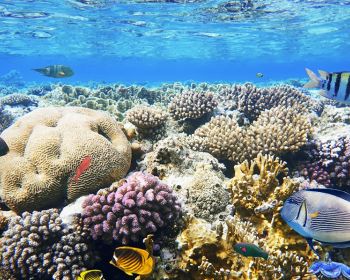
One of the unique features of this BNP Paribas Foundation programme is the way it involves BNP Paribas employees, who are also asked to take part in the evaluation of projects applications. In total, 120 evaluators from across all BNP Paribas entities and many different countries were mobilised for the first evaluation phase.This was followed by a second phase, led by a committee of nine international scientists: "Each project is evaluated at least three times by the scientists, ensuring a level of rigour comparable to academic standards. In the final phase, the scientific committee selects on average only one project in three, ensuring the highest possible quality."For Cécile Advani, this year's call for projects was a real success: "All depths of the Ocean are being explored, from coastal waters to the open sea and abysses." The 11 projects selected cover a wide variety of geographical areas, from the Arctic to the Mediterranean, including the Coral Triangle and the Gulf of Guinea. These projects also explore a diversity of species and issues, ranging from the resilience of corals reefs to heat waves to the study of new migratory corridors for large marine species. "The Ocean is an exceptional reserve of biodiversity that we still know too little about because it is complex and costly to study ecosystems 4,000 metres below the surface. In a field still described as 'terra incognita', the stakes are high: to produce key knowledge that will enable us to preserve the Ocean and identify solutions for the future," concludes Advani.
Want to learn how this initiative concretely supports research teams ?
Discover 2023 project winner Deeplife: Led by Lorenzo Bramanti, researcher at CNRS and expert on coralline algae ecology, Deeplife aims to map and understand marine animal forests globally by comparing terrestrial forests and marine forests to protect these species and their ecosystems.
Tara Ocean, a long-standing partner of the Group
Founded in 2003, the Tara Ocean Foundation is the first French foundation recognised as a public utility in France that is dedicated to the Ocean. Tara Ocean carries out large-scale sea expeditions and develops high-level Ocean science in collaboration with partnering laboratories. The data collected on board Tara, which was already used in one of the research projects supported during the BNP Paribas Foundation's previous call for projects, will be used once again by one of this year’s winners, the CNRS's "CoralResist" project.
As part of its investment‑product offering that supports charitable causes, BNP Paribas CIB launched a partnership with the Tara Ocean Foundation in 2020. BNP Paribas Private Banking was the first supporter of this initiativeand has remained its main contributor, providing more than €2.9 million in global support through its investment products with payouts, ensuring that strict exclusion filters are applied to the oil and gas sector. This support has notably contributed to financing the construction of the Tara Polar Station, the new floating scientific base dedicated to studying the Central Arctic Ocean, by covering 13% of the total budget: "The challenge of Ocean preservation concerns all of us. Only collective action, and ubsequently collective investment, can help us achieve this goal." explains Romain-Troublé, marine biologist and CEO of the Tara Ocean Foundation.
"The challenge of Ocean preservation concerns all of us. Only collective action, and ubsequently collective investment, can help us achieve this goal."Romain Troublé, CEO of the Tara Ocean Foundation and marine biologist.
Following the inauguration of Tara Polar Station in 2025, ten consecutive expeditions are planned until 2046. The first expedition, Tara Polaris-I, is set to begin in the summer 2026. This project is part of France's Polar Strategy 2030, which aims to strengthen scientific research in the Arctic and improve understanding of the Arctic environment. This long-standing collaboration illustrates BNP Paribas' continued commitment to scientific research on climate and biodiversity, as well as raising awareness and protecting marine life.

Producing and publishing open source scientific research
At a time when economic players are increasingly expected to demonstrate transparency and robustness in their environmental approaches, BNP Paribas is taking a new step forward: producing and publishing open source scientific research that is accessible to the entire academic, technological and financial community. We met with Imène Ben Rejeb-Mzah, Head of the Data Analytics & Research on Environment (DARE) team. Her team is conducting fundamental research in a still-emerging field: quantifying the risk of biodiversity loss.

The research papers published by Ben Rejeb-Mzah's team include a series focused on quantifying the risks of biodiversity loss. "There is an emerging concept of the biodiversity footprint, which is inspired by the carbon footprint, but much more complex to quantify or model. Unlike carbon, there is no 'universal unit' of biodiversity loss. The latter is based on three main dimensions: species and gene diversity, species interactions in the form of networks, and the ecosystem services provided by this biodiversity," explains Ben Rejeb-Mzah.
Published in June 2025, on the occasion of UNOC and the BEFF, one of these studies was specifically dedicated to modelling the marine footprint of large companies: "We initially studied the different units to measure the loss of terrestrial biodiversity in one of our first research papers. Then we asked ourselves about the marine biodiversity footprint. Is it accurately estimated? Can we assess the maturity of its modelling compared to that of the terrestrial biodiversity footprint?"

The team's work has shown that certain pressures, such as algal blooms and chemical pollution, are now modelled in a sufficiently robust manner – "open source and peer-reviewed by other researchers," explains Ben Rejeb-Mzah – to support footprint measurement tools. "We have seen initiatives and attempts to model another pressure, namely overfishing, but the majority of marine pressures still remain to be quantified. This is a huge field of research," Ben Rejeb-Mzah continues, before concluding: "Marine biodiversity is one of the invisible drivers of global climate, food and economic stability. Yet it remains the least understood and least quantified. By sharing our research on quantification methodologies in open source, we want to contribute to the collective advancement of science in this field."