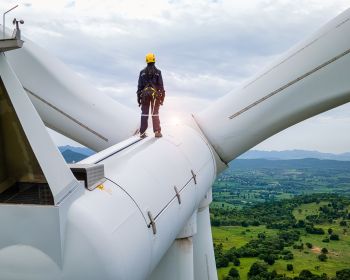
Promoting STEM and science career pathways
Organised by the Cercle de Giverny, the World Giverny Forum presented 30 proposals for more sustainable companies. These proposals were developed between April and June by a working group of actors from the private, non-profit, public and academic sectors. Six major themes structured the discussions: cities and housing; energy and digital technology; mental health; critical infrastructure; water; and scientific pathways.
During the round table dedicated to scientific pathways, Anne Pointet, Head of Company Engagement at BNP Paribas and member of the Group's Executive Committee, shared the Group's vision and concrete actions to support careers in the field of science, encourage more women to enter these fields and promote greater collaboration between the academic and business worlds.
Five key recommendations from the working group focused on supporting science career pathway in France and Europe (co-chaired by Bruno Leroux, Head of Environment at the BNP Paribas Foundation):
- Make experimentation the basis of scientific education from primary school onwards to stimulate curiosity and critical thinking.
- Create a national network of women ambassador scientists to promote gender diversity in STEM (science, technology, engineering, and mathematics) where women are often underrepresented and inspire young girls to consider careers in science and technology.
- Promote cooperation between research and business as a driver of innovation by strengthening public-private partnerships.
- Structure a national strategy for scientific literacy to anchor science in society and make it more accessible.
- Guarantee access to quality scientific information to fight against disinformation, develop critical thinking and promote scientific research professions.
Promoting the fields of science and STEM is a major societal and economic issue. As the speakers at the round table pointed out, the shortage of engineers and tech specialists is a challenge that goes beyond the educational framework and is now a strategic issue of economic competitiveness.
"It is important to finance access to science for all from childhood to give the same social opportunities to families and to promote women in science careers who can act as role models to inspire young girls, such as astronaut Sophie Adenot, who shows that space is attainable."

For BNP Paribas, fundamental research and innovation are real vectors of progress and long-term value creation, and investing in science is now a performance imperative. "They are essential in growth sectors such as space, health, quantitative finance, mobility and energy," explained Anne Pointet. Furthermore, the challenge is two-fold, because it is also a question of promoting gender equality: "It is important to finance access to science for all from childhood to give the same social opportunities to families and to promote women in science careers who can act as role models to inspire young girls, such as astronaut Sophie Adenot, who shows that space is attainable."
Valuable skills for the financial sector
Investing in employees and skills development is essential to adapt to the changing world. For Sarah Roussel, Head of Human Resources at BNP Paribas and member of the Group's Executive Committee, this is obvious: "Beyond its core business as a banker, BNP Paribas is a company that puts technology at the service of its clients and employees. For example, we need engineers and data scientists to work in a variety of fields: infrastructure, decision support systems, risk management, optimisation of financial decisions on the trading floor, regulation, compliance, etc."
Data has therefore become an asset for companies. BNP Paribas has developed in-house research and expertise centres such as DARE, "Data Analytics and Research on the Environment", led by data scientist Imène Ben Rejeb-Mzah. This team of data scientists conducts research on the quantification of biodiversity loss and develops models to measure the alignment of financial portfolios with low-carbon trajectories. In their everyday work, these specialised data scientists often employ mathematical models, geospatial analysis techniques and artificial intelligence (AI) when relevant and useful to their research.
Mathematics is at the heart of many of the Bank's businesses, including quantitative finance, modelling, AI, etc. In addition to the Group’s in-house research and expertise centres, BNP Paribas is a sponsor of the Institut des Hautes Etudes Scientifiques (IHES), where Hong Wang, a mathematician who won the Fields Medal in 2026, is a permanent professor. This sponsorship allows the Group to support the sciences and play a role in in France's academic influence.

"Investing in fundamental research is not about financing uncertainty, it is about preparing for the major scientific, technological and economic breakthroughs of tomorrow. In finance, as in many other sectors, mathematics is already fuelling innovation, from risk management to artificial intelligence. Today's discoveries shape tomorrow's solutions."

Working within an ecosystem to create value
A systemic approach that brings together public actors, companies and the academic world is absolutely necessary for creating innovation that is sustainable in the long term. This involves supporting university chairs and continuous professional development, as well as forging partnerships with higher education such as France’s “grandes écoles” and promoting apprenticeships.
Scientists and researchers need funding, but they also need greater visibility and recognition of their important work. As such, the BNP Paribas Foundation’s Climate & Biodiversity Initiative programme is dedicated to supporting researchers who are either working on their doctoral theses or on research later on in their careers.
Bruno Leroux, Head of Environment at BNP Paribas Foundation and co-chair of the working group dedicated to scientific careers in Giverny, said: "BNP Paribas stands out for its support of fundamental research, in particular through the funding of more than 500 scientists around the world since 2010.The 2025-2028 cohort supports 11 projects that explore the links between climate change and biodiversity based on the theme of ‘Ocean & Coastal Ecosystems’."
And as Anne Pointet explained, inspiration is essential. To inspire as many people as possible and remind us that science allows us to dream big, BNP Paribas is also a partner of the documentary series "HOPE - Dreams never die", directed by Sébastien Blémon. The next episode of this series is dedicated to French ESA astronaut Sophie Adenot who is currently onboard the International Space Station (ISS) as part of the Epsilon mission before a landing this autumn. Her work during this mission involves working on more than 200 experiments. One experiment in particular, ChlorISS, was carried out simultaneously by Sophie Adenot on the ISS and by 4,500 classes throughout France. Proof, once again, that dreams are often formed early in the classroom!