Strong Financial Support for Renewable Energies
The FBF reports that French banks rank among the world’s leading financers for renewables with 102 billion euros in outstanding financing dedicated to renewable energies. At the end of September 2025, BNP Paribas had dedicated 35.6 billion euros to support renewable energies, with low-carbon energies – renewable and nuclear – representing 82% of the Group’s credit exposure to energy production.
Furthermore, French banks' outstanding green and sustainable loans increased by 37% in two years, representing 510 billion euros in 2025. BNP Paribas allocated 252 billion euros to support the transition of its clients between 2022 and 2025, well surpassing the Group’s initial target of 200 billion euros. This amount includes sustainable loans, sustainable bonds and financial support and advice. For example, this financing supports the purchase of electric vehicles, home energy renovations, investments in major renewable projects, and the issuance of sustainable bonds to develop infrastructures to adapt to climate change.
According to Dealogic’s ranking sourced in the FBF’s study, four French banks are in the world's top 12 banks for green and sustainable loans and bonds in 2025. In fact, BNP Paribas ranks as the world's #1 bank in this category for the third year in a row.
Financing low-carbon energy
Amount of financing (credit exposure) allocated to low-carbon energies -in 2022: 28.2 billion euros -in 2025: 38.3 billion euros The target in 2030 is more than 40 billion euros.
Maintaining a Strategy to Decarbonise Credit Portfolios
In addition to supporting low-carbon and renewable energies, French banks have set specific targets for the decarbonisation of their credit portfolios by sector, generally with greenhouse gas emissions intensity targets based on the IEA's (International Energy Agency) 2050 net zero scenarios. In terms of energy, there’s the power generation sector, whose greenhouse gas emission intensity linked to their credit portfolios in 2025 amounted to only 121 gCO2/KWh compared to 434 gCO2/KWh globally according to the IEA. More specifically, BNP Paribas has sharply reduced its emission intensity since 2022, from 179 gCO2/KWh in 2022 to 119 gCO2/KWh in 2025.
The FBF study also reports that no French bank is in the 2025 global market’s top 20 for financing the fossil fuel sector, neither for loans nor for the structuring of bond issues. In 2019, French banks committed to completely phasing out thermal coal by no later than 2030 in OECD and EU countries. At the end of September 2025, BNP Paribas had only a very residual exposure to thermal coal, making up less than 0.7% of its portfolio of energy financing.
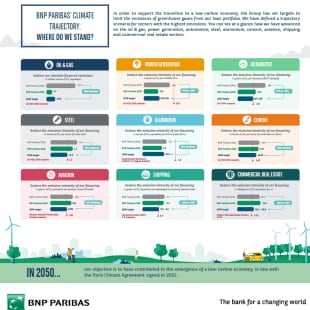
BNP Paribas regularly publishes its progress in reducing its emissions in nine sectors that are among the most difficult sectors to decarbonise: Discover the Group’s progress at a glance in the oil and gas, power generation, automotive, steel, aluminium, cement, aviation, shipping and commercial real estate sectors.
Sustainable Loans and Bonds to Finance the Transition
In 2025, the Bank issued green loans that directly finance projects with a positive environmental impact. For example, the 450 million euro green loan to IONITY, a German player in electric mobility, to finance the development of its European network of charging stations. This is one of the largest loans issued in the European electric charging industry to date.
In addition, BNP Paribas issued Sustainability Linked Loans (SLLs), financing whose terms change based on ESG (environmental, social or governance) performance objectives met. This is the case of the 700 million euro SLL granted to the French public transport group Keolis, linked to three types of ESG performance indicators dedicated to climate, health and safety.
Green Bonds to Support Major Renewable Energy Projects…
French banks are also supporting their clients' transition through the arrangement of bond issues with 103 billion euros in green and sustainable bonds structured in 2025.
Green bonds are loans issued on the financial markets to exclusively finance projects that have a positive impact on the environment. BNP Paribas is a leader in the green bond market and has supported many regions in the development of their low-carbon energy infrastructure. Returning to the energy sector, the 5.5 billion pounds in financing dedicated to the construction of two new EPR nuclear reactors in the United Kingdom (Sizewell C) with a combined capacity of 3.2 GW is a must for 2025.
With its expertise on renewable energy projects strengthened over time, the Group supports the financing of the entire low-carbon energy value chain, such as its financing for power grids, with Eurogrid. BNP Paribas supported the first European green bond issued to integrate renewable energies into the grid for 1.1 billion euros.
... and Concrete Actions for Biodiversity Protection and Sustainability Trainings
French banks that are members of coalitions are also leveraging these groups to carry out collective actions. For example, BNP Paribas is a member of the coalition “Entreprises pour l'Environnement” (EpE), which spearheaded the international Act4Nature initiative. The initiative’s objective? To find solutions to preserve and restore biodiversity. Most French banks are also members of the Poseidon Principles, the leading international framework for climate alignment in shipping.
BNP Paribas allocated 6 billion euros in financing to companies helping to protect terrestrial and marine biodiversity by the end of 2025 (largely exceeding the initial target of 4 billion euros). For example, the Group arranged 130 million euros in blue bonds for development banks in Latin America; participated in a 500 million euro blue bond issuance to finance wastewater collection and treatment and seawater desalination solutions with less environmentally impactful technologies (SAUR); and contributed to the protection of the Ocean through an impact loan facility with the NGO Blue Alliance to finance the effective management of Marine Protected Areas (MPAs).
Today, BNP Paribas bankers have the capacity to offer financing to their clients to contribute to the environmental transition. This social and environmental responsibility approach is integrated into the Group’s business. Moreover, the FBF study notes that beyond specialised professions, a growing proportion of French bank employees are fully aware of ESG issues thanks to dedicated training modules. By the end of 2025, nearly 500,000 French bank employees had received training on ESG subjects. Looking specifically at BNP Paribas, 160,000 employees have already taken part in at least one training on sustainable finance since the Group’s launch of its dedicated “Sustainability Academy” trainings in 2022. This includes nearly 71,000 employees trained in 2025 alone.
An Award-Winning Sustainable Finance Strategy
BNP Paribas ranks above average among its peers among various ratings agency rankings:
- The Group maintains its status as #1 in the world in sustainable finance bonds and loans for the third year in a row, for a total amount of US$69 billion in 2025 according to Dealogic;
- The CDP (Carbon Disclosure Project) ranking, which assesses the environmental performance and transparency of companies, gave the Bank an A- rating, which is well above the average B rating of the 416 financial institutions assessed;
- MSCI gave BNP Paribas a AAA rating, its highest rating, in March 2026;
- The Bank received the highest score ever achieved by Sustainalytics, which measures non-financial risks, with a score of 12.3;
- BNP Paribas is also the only French bank in Corporate Knights' "Global 100 Most Sustainable Corporations" ranking in 2026. The Group was included in this ranking for the twelfth consecutive year in a row.
- BNP Paribas’ expertise was also recognised by Environmental Finance, the media group specialised in sustainable finance, with the award for "Lead Manager of the Year for Corporate Green Bonds" at the 2026 Sustainable Debt Awards.