"2025 confirmed BNP Paribas' sustainable finance trajectory, for and with our clients. Our GTS strategic plan boosted this momentum by bringing together all our entities. It has enabled us to support our clients in their transitions even more than anticipated. With an initial target of 200 billion euros, the Group has already dedicated 252 billion euros to supporting our clients in their transition at the end of 2025. Low-carbon energies now account for 82% of our credit exposure to energy production, and we are proud to promote energy sovereignty in this way. Our emission intensity reduction targets for the most emitting sectors now are all set through 2030. In terms of sustainability, as with everything, BNP Paribas continues to plan for the long term."

BNP Paribas Supporting its Clients' Transition
In the spring, BNP Paribas publishes its annual Universal Registration Document (URD). Released on 19 March this year, the document is more than 900 pages, making it an incredible data source! For the last few years, the sustainability topics and CSR achievements in the URD have been condensed and summarised into a brochure to make this information more easily accessible. Titled "BNP Paribas Supporting its Clients' Transition", this document offers a complete vision of the Group's strategy to support the transition of all its clients, from individuals and startups, to companies and institutions. This document also includes examples of financing that promotes the energy and ecological transition, biodiversity and social and financial inclusion.
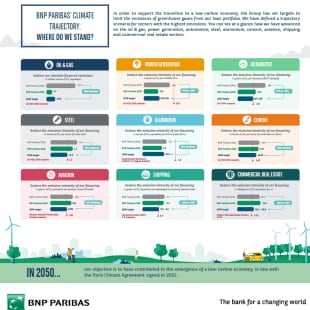
Emission reduction targets for the most emitting sectors
BNP Paribas closely monitors nine of the sectors of activity that emit the most greenhouse gases and shares its progress each year in the URD’s Chapter 7 under the "Sustainability statements" (CSRD) section. This year, the Group set new targets for the power generation and automotive sectors since the initial targets were set through the end of 2025. The Group’s 2030 targets aim to reduce the emissions intensity of its financing by between -47% and -40% for electricity generation and between -37% and -26% for the automotive sector, compared to 2020 reference levels.
This new format is part of the Group's LinkedIn newsletter "Sustainable Finance at Scale". Join more than 675,000 newsletter subscribers, to receive a curation of our sustainable finance news in English every month!