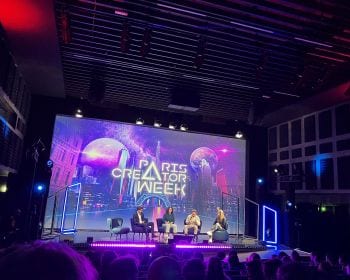
The Creator Economy: a key pillar of the digital sphere
Long perceived as a niche phenomenon associated with influencers and social media, the Creator Economy has now become a key pillar of the digital economy. According to the Creator Economy Report 2026, the global market is worth $217.3 billion in 2026, representing year-on-year growth of 26.2%. Since 2020, its value has more than tripled, rising from $65.2 billion to $217.3 billion, with an average annual growth rate of 22.2%.
This growth is largely driven by brands and advertisers. Nearly 80% of the market’s value now comes from their investments, whether in advertising, sponsorship, partnerships or affiliate marketing. Creator partnerships alone represent the industry’s largest source of revenue. However, creators do not receive all of this spending: for every $100 spent by advertisers, the study estimates that approximately $35 goes directly to creators, while platforms capture around $40, with the remainder going to agencies, technology providers and various service providers.
Behind the market’s strong growth also lies a significant concentration of income. Of the approximately 11 million active creators identified by the study worldwide, 7.7 million generate revenue, but fewer than one in ten of these earn at least $30,000 a year, the threshold used in the report to define a creator’s main professional activity. The top 10% of earners also account for approximately 60% of total creator income.
Finally, according to the Creator Economy Report’s moderate growth scenario, the global market could reach $380.1 billion by 2030.
The Creator Economy worlwide: key figures
Estimated value of the global Creator Economy market in 2026
Potential estimated market value by 2030
Estimated direct and indirect full-time equivalent jobs (FTEs)*
*Full-time equivalent: one employee working full-time over the course of a year or month.
The Creator Economy in France: a rapidly growing market
France holds a significant position within this ecosystem. Its market is valued at $10.1 billion in 2026, representing nearly a quarter of the European market. It ranks 7th worldwide and 3rd in Europe, behind Germany and the United Kingdom.The report estimates that there are approximately 465,000 active creators in France. The study also estimates that 31,273 French creators earn at least $30,000 per year, representing 9.5% of monetised creators.
Hight-potential sectors for creators in France
France has several key strengths, particularly in luxury, fashion and beauty, sectors in which its major international groups are already highly engaged with creators. French content also benefits from an audience that extends well beyond the country’s borders: according to data cited in the report, 60% of watch time for French content on YouTube comes from outside France. However, this international audience is still not fully monetised.
The study therefore concludes that France’s main challenge is not to produce more talent, but to enable creators to turn their activities into businesses, retain greater ownership of intellectual property and expand more effectively internationally.

The Creator Economy in France: key figures
Value of the French market in 2026, up 23.7% year on year
estimated FTEs (186,000 direct FTEs and 41,000 indirect FTEs)
2026: a consolidation phase for the Creator Economy
According to the Creator Economy Report 2026, the acceleration of mergers and acquisitions is a long-term trend. Following a period of extensive business creation in 2020 and 2021, the sector is entering an era of consolidation. The report identifies 69 transactions in 2024, 81 in 2025 and 70 in the first half of 2026.Agencies, technology, data, media, commerce and talent management businesses are gradually being brought together within larger organisations. These transactions mainly involve agencies, technology, data, media, commerce and talent management, which are progressively being consolidated into larger groups.
France: a key player in this consolidation trend
While North America accounted for more than 60% of transactions in the first half of 2026, Europe, and France in particular, is also actively participating in this trend.The report* identifies 13 transactions involving French companies between 2021 and 2026. Some French businesses are becoming investment or acquisition targets, while others are building European platforms through acquisitions. At the same time, major French groups such as Publicis are acquiring creator, technology and data companies internationally.This shift is having a significant impact on how investors value companies in the Creator Economy. Follower numbers or a creator’s profile alone are no longer enough. Investors are increasingly focusing on recurring revenue, diversified customer bases, proprietary data, intellectual property, brands, technology and teams capable of operating independently from the founder.
The key question therefore becomes: how much of the company’s value would remain if the creator were to step away from the business?
*Non-exhaustive figure

The Creator Economy has now established itself as an economic sector in its own right, driven by the emergence of structured businesses and the arrival of new investors. The increasing number of mergers and acquisitions illustrates this new phase of maturity. Drawing on its longstanding expertise in media, entertainment and the creative industries, BNP Paribas supports this new generation of entrepreneurs as they address their financing, development and consolidation challenges.”
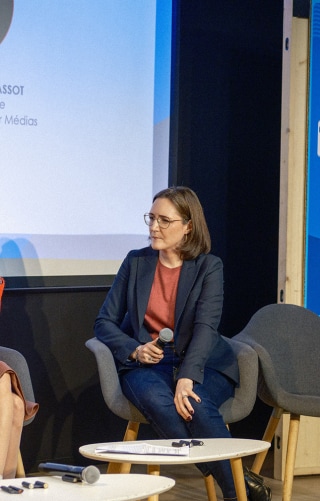
Looking ahead to 2030, the report depicts a much more structured industry, with the Asia-Pacific region, and China in particular, gaining significant momentum.At the same time, creators are expected to become increasingly integrated into companies, not only as advertising partners, but also as partners in content creation, product development, brand building and intellectual property development.The Creator Economy is gradually shifting from an economy primarily based on audience reach and individual influence towards an industry in which value also lies in structured businesses, recurring revenues, assets, intellectual property, technology and access to financing.This wave of consolidation illustrates the transition from a market historically made up of independent players to an ecosystem of structured businesses, in which financing, external growth and international expansion are playing an increasingly important role.