
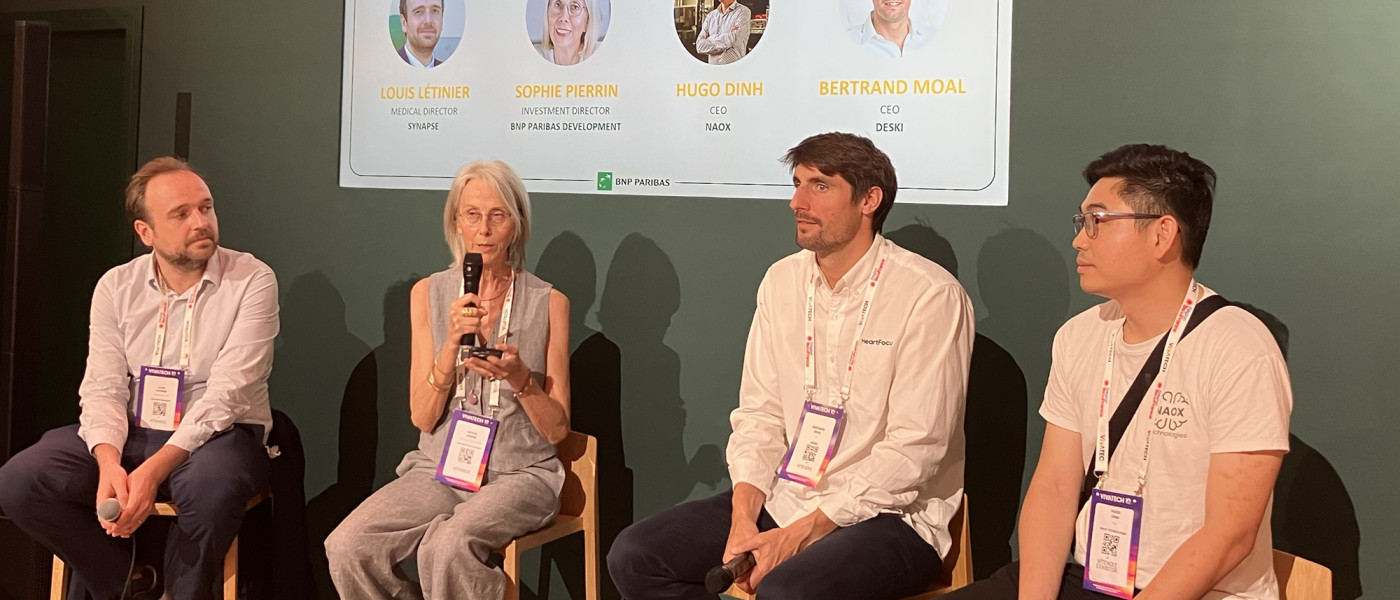
France’s medical AI champions: pioneers on a demanding journey
Healthcare professionals are short of time. Patients are older, their conditions more complex, and they require an increasing number of treatments. And advances in medicine itself have never been so rapid. It is precisely this challenging healthcare environment that AI is beginning to transform: accessing the relevant medical knowledge for any given clinical situation in a matter of seconds, extending cardiovascular screening beyond cardiologists alone, and monitoring a patient’s brain activity from their own home. These applications are no longer theoretical. They are currently being rolled out in French healthcare facilities by entrepreneurs from the medical world who understand these challenges first-hand.
Three breakthrough innovations born from real-world needs:
- Synapse Medicine, founded by two doctors and an engineer, has developed MedGPT, France’s first AI medical assistant. MedGPT is now used by more than 200,000 healthcare professionals in France.
- DESKi has developed software that enables any healthcare professional to perform a cardiac ultrasound scan. Cardiovascular diseases are the leading cause of death worldwide. While cardiology already has widely available consumer technologies, such as ECG functionality in smartwatches, the brain remains a blind spot in digital health.
- NaoX Technologies captures brain data using standard earphones. Naox Link, the first in-ear EEG, has been named one of the 300 innovations of the year 2026 by TIME!
But scaling up these solutions – and making them accessible – is another matter entirely: convincing organisations under pressure, integrating into existing practices, obtaining the necessary certifications, demonstrating measurable clinical benefit… These are all steps that take years and require a partner capable of "staying the course".
The key: bespoke, long-term support
Over ten years of venture capital investing, BNP Paribas Développement has learnt that investing in a medtech company means making a long-term commitment, well beyond the initial funding. Identifying who ultimately pays, structuring a viable business model, supporting teams within a complex regulatory environment: on all these fronts, BNP Paribas Développement works closely with these innovative start-ups, from their initial fundraising rounds right through to large-scale roll-out. For, in healthcare more than in any other sector, the user of a tool is not the one who funds it, and finding the right business model is an innovation in its own right.
- Synapse Medicine is exploring a novel model, made possible by the Social Security Financing Act for 2026 (Act No. 2025-1403 of 30 December 2025). MedGPT could be funded by the French state on the basis of the savings generated within the healthcare system, making the tool free for healthcare professionals.
- NaoX Technologies is relying on licences granted to manufacturers of consumer earbuds to support its research over time.
- DESKi combines several approaches within a rapidly evolving regulatory environment.
Three distinct models, united by a single goal: to improve public health and preserve a ‘universal and sustainable’ healthcare model.
Our business models must demonstrate the economic benefit we can bring to the healthcare system".
European medical sovereignty: time to choose
Behind these economic challenges lies a more fundamental issue. In a few years’ time, a large proportion of medical decisions will increasingly be assisted by AI. “Healthcare professionals in a single university hospital make around one million AI queries every month. Multiply that by the number of university hospitals in France and the issue of sovereignty becomes immediately apparent,” notes Louis Létinier, co-founder of Synapse Medicine.
The question is no longer whether this transformation will take place, but where these tools will be developed, on what data they will be trained, and according to what ethical standards. Hugo Dinh, CEO of NaoX Technologies, observes: “We want to advance medicine. But medical data can easily end up in the hands of others whose intentions may not align with ours.”

France and Europe have the talent and technology to shape this transformation. They also have a distinctive vision of healthcare as a common good, underpinned by universal healthcare systems and strong ethical standards. This distinctive vision is a competitive advantage that must be protected. Funding French healthcare companies means helping to ensure that this vision guides tomorrow’s medicine. Medical sovereignty cannot be imposed by decree. It is built by supporting disruptive start-ups over the long term.
BNP Paribas Développement: 10 years of venture capital specialising in healthcare
In 2026, BNP Paribas Développement is celebrating ten years of its venture capital activity, dedicated to supporting innovative companies, particularly in the healthcare sector. As an "Evergreen" investor, BNP Paribas Développement has helped shape an ecosystem where medical innovation and European technological sovereignty are strengthened. Sophie Pierrin Lépinard, Head of Investments, looks back on this decade, the challenges faced by the startups it supports, and the vision that guides BNP Paribas Développement in this demanding sector.
3 questions for Sophie Pierrin Lépinard, Head of Investments
-
Ten years ago, the MedTech start-ups we supported were focused on specific areas: a single device, a specific procedure, or a particular patient segment. Today, their ambitions have grown dramatically. They aim to transform entire practices, reorganise care pathways and reach millions of patients. And the technologies they are harnessing (AI, natural language processing, neurotechnology) give them the means to realise their ambitions. What hasn’t changed is the depth of commitment required: the medical innovation cycle is long, the evidence requirements are rigorous, and finding the right business model remains the central challenge. This is precisely where our role as an investor adds real value.
-
We invest directly, using our own capital, without a fixed investment horizon, which allows us to remain involved over the long term that these ventures require. But our role goes far beyond financing. We support these companies in structuring their business models: identifying who ultimately pays, building the evidence that will gain acceptance from public authorities, and navigating a complex regulatory environment. Some of these business models did not even exist a few years ago, such as the direct contracting with the French social security system that Synapse Medicine is implementing. It is this kind of innovation – both economic and technological – that we seek to help bring to scale.
-
Absolutely. When we support companies developing medical decision-support tools for patients, we gain a very tangible understanding of what dependence on foreign players entails. This is not an abstract question: it is a question of who will guide tomorrow’s medical decisions, based on what data, and according to what values. Investing in French healthcare companies is our way of helping to ensure that the answer to this question remains rooted in Europe, and that reflects the values embodied by our healthcare systems.
Three MedTech that are integrating AI into their innovations
Synapse Medicine
Synapse
Medicine is developing MedGPT, the first French medical AI assistant dedicated to healthcare professionals.
In seconds, the tool synthesizes available medical knowledge and provides healthcare professionals with contextualized answers tailored to each patient.
Read our article about Synapse MedicineDESKi
DESKi develops HeartFocus, a software to perform a cardiac ultrasound examination after a few hours of training. The objective: to democratize cardiovascular disease screening, by allowing it to be carried out beyond cardiologists alone.
Discover heartfocusNaoX Technologies
NaoX Technologies is developing a technology for capturing brain data (EEG) via simple headphones. The objective: to eventually build a large-scale neural database for medical research.
Learn more about Naox TechnologiesBNP Paribas Développement
From venture capital to private equity, follow all of BNP Paribas Développement's activities on LinkedIn